Near-Future Fiction
A Tale of Two Outcomes
Same world. Same beginning. Two futures.
Prologue: The Geologist
He had carried the thought for years the way you carry something you don't yet know what to do with — turning it over occasionally, setting it down, picking it up again when the news was bad or the sky was clear and the stars were visible and the distance between now and the end of things felt measurable.
The thought was simple. Almost embarrassingly simple for something that had taken so long to fully reckon with.
Earth is the only spaceship we know of with no plan.
He was a geologist. He had spent his life reading the record of how planetary systems behaved over time — how they absorbed stress and how they failed, how slowly they built the conditions for complex life and how quickly those conditions could unravel. He understood, in a way that went past knowing into something more physical, that the current moment was not ordinary. That the instruments were reading something they had never read before.
His mother had been a nurse. From her he had received something different and equally essential — the willingness to sit with what was fragile without flinching, to care for it steadily, to understand that love was not a feeling but a practice. He had lost two brothers to motorcycles. Fourteen years apart — the first loss arriving before he fully understood what loss was, the second arriving just when he thought he did.
He thought about time running in two directions at once — backward through the rock into deep history, forward into a future that required someone to be there to count the hours. He had four daughters whose lives extended into the century he was beginning to write toward. He had a grandson whose life extended further still — a boy who would be a man when the consequences of the present decade arrived in full.
He lived on a small volcanic island in the Atlantic. He had chosen it, in part, because living on a volcano is a reliable reminder of what the planet actually is — not a backdrop for human activity but the condition of its possibility. He had also lost enough to understand that love was not a sentiment but a practice — something you did, repeatedly, in the face of everything that argued against it.
One autumn he sat down and began to write. Not because he thought it would be easy. Not because he was certain it would matter. But because the thought had been carried long enough and the world needed a plan and he was, after all, someone who read the rock.
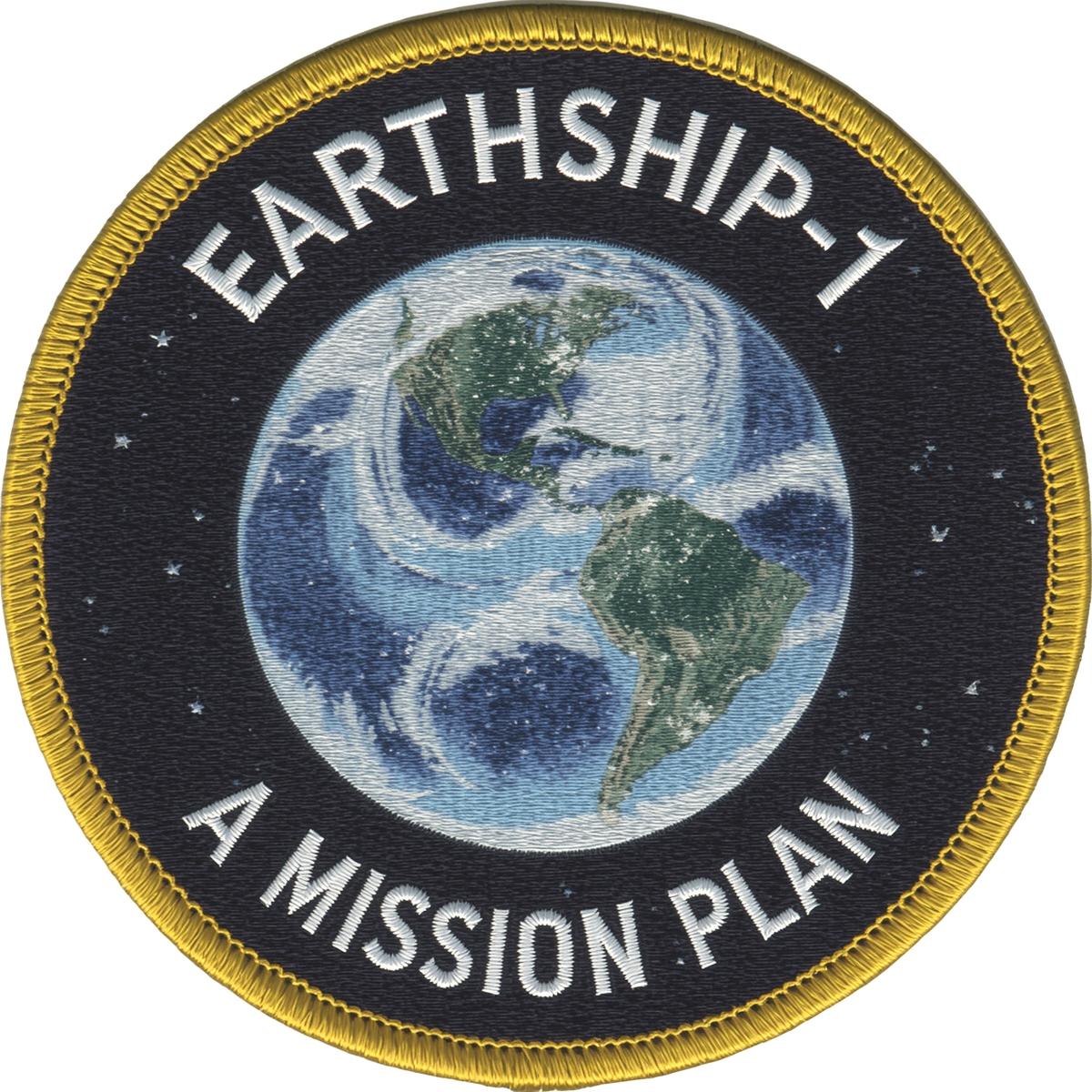
A few emails. A website. A mission patch made on a laptop on a volcanic island, gold-bordered, the Earth centered in space, the words circling it like a prayer or a directive or both:
EARTHSHIP-1. A MISSION PLAN.
He did not know about Daniel Marsh. He did not know about Sarah. He knew only that the thought had been carried long enough. That the path ahead was difficult. That it was more solvable with a plan than without one. That his grandson would be alive when the answer arrived.
And that was enough to begin.
The Same Beginning
In the autumn of 2025, a geologist living on a small volcanic island in the Atlantic finished a manuscript. It was not a long book. It was not a famous book — not yet, and perhaps not ever. But it asked a question that had been waiting a long time to be asked out loud:
Why is Earth the only spaceship we know of with no plan?
He sent it out into the world the only way he knew how. A few emails. A website. A handful of printed packages mailed to governors' offices by a friend in the American Southwest who believed, as he did, that the most complicated collective act in human history was still worth attempting.
What happened next depended entirely on who was listening.
In a farmhouse outside of Mineral Point, Wisconsin, a young man named Daniel Marsh sat at his kitchen table after the others had gone to bed. The lamp above him cast a warm circle on the old wood. Outside, the fields were dark and quiet. He had found the manuscript online and begun reading the way you read something you don't yet know will change you.
He was twenty-nine years old. He had been watching his yields decline for four years. He had watched the creek that ran along the eastern edge of his property run lower each summer, and he had felt, without having words for it, a dread that was different from ordinary worry — something older and more physical, like the sensation of standing on ground that has shifted.
The manuscript named it. That was the thing. It named the dread and gave it a shape and then — and this was what kept him sitting at the table long after he should have slept — it said the shape could be worked with. That there was a plan to be made. That the making of it was the most important thing anyone could do.
Upstairs, his wife Sarah was nursing their second child, a girl born three weeks earlier, still nameless in the way of children whose parents cannot yet believe they are real. Sarah heard Daniel come upstairs and she asked, quietly, what he had been reading.
He told her. Not all of it — it was late and she was exhausted — but the essential thing. The spacecraft. The crew. The plan that didn't exist. The plan that could.
She was quiet for a moment. Then she said: that's what I've been trying to say since she was born.
In the dark they lay with the baby between them and the weight of the idea above them and neither of them slept for a long time.
What happened next depended entirely on who was listening.
Outcome One: The Plan
The aide who took Daniel's call was twenty-four years old and had read the same manuscript three weeks earlier, passed to her by a professor whose class she had audited the previous spring. She put Daniel through.
Daniel was not eloquent in the meeting. He was a farmer, not a speaker. He brought notes he had written at the kitchen table and he read from them in a quiet voice. The policy director called the governor. The governor called Colorado.
Daniel drove home and told Sarah what had happened. She was sitting in the kitchen feeding the baby, who still had no name, and she listened to everything he said and then said: not your Thursday group. Something different. For the women I know who are holding babies right now and terrified about what world they're handing them.
She called it, with characteristic plainness, the Legacy Circle. It began with four women around Sarah's kitchen table on a Wednesday afternoon. They talked for three hours — about their children and their mothers and their grandmothers, about what had been passed down and what they wanted to pass down and what they were afraid would be taken away.
By spring there were twelve women. By summer there were thirty, meeting in three different locations across the county. Meanwhile Daniel had not stopped — a Thursday evening group in Mineral Point, neighbors around a table, the manuscript printed out and passed around.
The manuscript had been traveling. Not through official channels — through kitchens and classrooms and community centers, forwarded by people who had downloaded it from a quiet website and passed it to someone they thought needed to read it. Signs appeared at demonstrations, hand-lettered and earnest: WE ARE THE CREW and BUILD THE ARCHITECTURE and the one that seemed to appear everywhere: YOUR GRANDCHILDREN WILL ASK.
It took three years for the Earthship Coalition to have a name anyone recognized. It took five for the first long-horizon governance legislation to pass in four states simultaneously — not identical bills, but coordinated ones, each designed to account for outcomes beyond any single electoral cycle. The Earthship Party never won a presidential election. It didn't need to. What it won was the framing — the slow, irreversible shift in what voters expected their leaders to be accountable for.
The life-support systems held. Not perfectly. Not without loss. The transition was hard and uneven and several things were sacrificed that should not have been. But the vessel held its course. The crew coordinated. The plan, imperfect as it was, existed — and because it existed, it could be improved.
In 2061, Daniel and Sarah sat on the porch in the evening light. Eleanor's daughter — their granddaughter, nine years old, curious about everything — sat between them and looked out at the fields and the creek that was running higher than it had in decades.
"What did you do, when it mattered?" she asked.
Daniel looked at Sarah. Sarah looked at Daniel.
"Your grandfather read something true," Sarah said. "And he came to bed very late and told me about it. And I couldn't unknow it."
"And then?" the girl said.
"And then we got up in the morning," Daniel said. "And we started."
The girl thought about this for a long time. Then she leaned back against her grandmother and looked up at the sky.
"I'm glad you didn't just go back to sleep."
Sarah laughed — a real laugh, surprised out of her. She put her arm around the girl and pulled her close.
"So are we," she said. "So are we."
Outcome Two: No Plan
The aide who took Daniel's call was polite. She took his name and number and said someone would be in touch. No one was in touch. Daniel waited two weeks and called again. He was transferred twice and reached a voicemail. He left a message that he listened to himself leaving and thought sounded strange — a farmer from Mineral Point, calling about the future.
He told Sarah what had happened. She was sitting in the kitchen feeding the baby and she said: I want to start something anyway. For the women I know who are holding babies right now and terrified. She called it the Legacy Circle. It began with four women around Sarah's kitchen table. More women came. By spring there were twelve. The conversations were real and necessary and sustaining. But the wider world did not respond.
Daniel started his Thursday evening group. Neighbors around a table, the manuscript printed out and passed around. A few came. The conversations were serious and good. There had been a moment, in the late 2020s, when something almost caught — signs briefly appeared at a handful of demonstrations, hand-lettered: YOUR GRANDCHILDREN WILL ASK. But the moment did not hold.
The fragility showed itself gradually. Women came to the Legacy Circle and were moved and went home and found that the world outside had not changed. The altruism that had driven Daniel to the capitol curdled, slowly, into something sadder. He was not bitter — that was important to him, not to become bitter. But refusal is not the same as peace, and the years passed and the moment did not come.
The transitions happened anyway, but badly — too late, too fast, without coordination, each crisis creating the next. The systems didn't collapse. They contracted. Slowly, then faster. The things that stopped working were replaced by smaller things. The things that were lost were mourned and then absorbed into the ordinary texture of a diminished world.
In 2061, Daniel and Sarah sat on the porch in the evening light. The creek bed was dry. It had been dry for eleven years. Eleanor's daughter — their granddaughter, nine years old, already serious in the way of children who have grown up amid contraction — sat between them.
"What did you do, when it mattered?" she asked.
There was a long silence.
"We read something true," Sarah said carefully. "And we believed it. And we tried to pass it on."
"Did it work?" the girl said.
The question landed in the silence between them like a stone in dry water.
"Parts of it," Sarah said finally. "The part that was us — that worked. The part that needed the world to meet us halfway —" She stopped.
"Maybe it just needed one more person to pass it on," Daniel said quietly. "And that person didn't."
The girl leaned back against Sarah the way children lean against grandmothers, with complete trust, and looked up at the darkening sky.
"I believe you," she said.
And Daniel reached over and took Sarah's hand, and Sarah held it, and they sat together on the porch in the last of the light.
"We did more than mean to," she said. "Don't say just tried. We did more than mean to."
He looked at her. And in the looking was everything — the kitchen table, the lamp, the manuscript, Eleanor's first night in the world, the Thursday evenings, the Wednesday afternoons, the creek when it still ran.
"We did," he said. And that was true. And it was not enough. And they both knew it. And they held each other's hands in the dark anyway, because that was what you did when you loved the world and the world had not loved you back quite enough.
The plan exists. The question is whether anyone reads it. The question after that is whether anyone passes it on. The question after that is whether enough people pass it on in time.